
By Correspondent
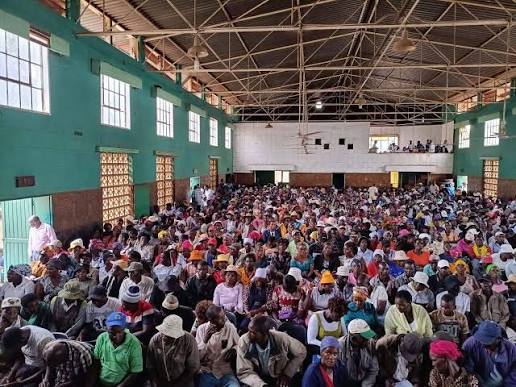
The just-ended public hearings on Zimbabwe’s Constitutional Amendment Bill No. 3 were marked by manufactured consent, disruption, and, in some cases, outright chaos.
Yet beyond the scenes that dominated headlines, another reality quietly unfolded.
One defined not by what was seen, but by what was missing.
The voice of civil society.
For a process built on the principle of public participation, the limited visibility of civil society organizations (CSOs) raises serious concerns about both the credibility of the hearings and the broader state of democratic engagement in Zimbabwe.
CSOs have long served as the bridge between citizens and the state, translating complex legislative issues, mobilizing communities, and monitoring governance processes to ensure transparency and accountability.
Their absence at such a critical national moment was not just noticeable – it was consequential.
Across several hearing venues, there was little sign of coordinated civic monitoring.
The structured presence that often characterizes CSO engagement – independent documentation, parallel reporting, legal observation, and civic education was largely absent.
What remained was a fragmented process, vulnerable to disruption and, at times, manipulation.
The Wider Problem
This silence does not exist in a vacuum.
It reflects a civic space that has been steadily narrowing under the weight of regulatory pressure and financial strain.
The proposed Private Voluntary Organisations (PVO) Amendment framework has introduced a climate of uncertainty within the sector.
Many organizations have increasingly become cautious about engaging in politically sensitive processes.
The risk of heightened scrutiny, or worse, deregistration, has forced some into scaling back their visibility, while others have retreated altogether.
Funding ChallengesAt the same time, a deepening funding crisis has compounded these challenges.
As global donor priorities shift and funding becomes more competitive, Zimbabwean CSOs are finding it increasingly difficult to secure resources.
This is particularly so for governance and accountability work.
Yet it is precisely this kind of work that is most needed during processes such as public hearings.
Monitoring requires logistics, personnel, and sustained coordination all of which depend on funding that is no longer guaranteed.
The consequences of this dual pressure regulatory and financial were evident throughout the hearings.
Reports of intimidation, disruptions, and what many observers described as “uniform support” shaped the narrative of the proceedings.
In some instances, dissenting voices struggled to be heard, while journalists faced restrictions in documenting events as they unfolded.
Without a strong and visible civic presence to independently track and verify these developments, the process risked losing its legitimacy in the eyes of the public.
The Historical Role of CSOs
Historically, CSOs have played a critical role in ensuring that such moments are not left unchecked.
They have documented irregularities, issued timely statements, provided legal support, and amplified citizen concerns beyond the confines of official platforms.
Their relative silence during these hearings represents more than a gap in observation.
It signals a weakening of one of the key pillars of democratic accountability.
What is at stake extends far beyond these hearings.
The diminishing presence of civil society points to a broader structural challenge within Zimbabwe’s governance landscape.
When civic institutions are constrained, the ripple effects are felt across the entire democratic ecosystem.
Citizens lose access to trusted intermediaries, the media operates with fewer collaborative partners, and policymakers are deprived of critical, independent feedback.
In such an environment, public participation risks becoming procedural rather than meaningful.
Hearings may still take place, submissions may still be recorded, but the depth, diversity, and authenticity of engagement are compromised.
The result is a process that appears inclusive on the surface, yet lacks the substance required to genuinely reflect the will of the people.
The Lost Space
Reclaiming this space will require more than acknowledgment.
It demands a deliberate effort to create an enabling environment in which civil society can operate freely, sustainably, and without fear.
Regulatory frameworks must strike a balance between accountability and autonomy.
This ensures that they do not inadvertently silence the very actors tasked with safeguarding public interest.
At the same time, there is a need to rethink how governance and accountability work is funded.
Recognizing it as an essential component of democratic development rather than an optional add-on.
The story of these public hearings will be told in many ways through the voices that dominated the rooms, the disruptions that halted proceedings, and the outcomes that will follow.
But perhaps the most telling narrative lies in the silence that surrounded them.
Because when the watchdogs are quiet, it is not always because there is nothing to say.
Sometimes, it is because the space to speak has quietly disappeared.