
By Correspondent
Once, whispered stories of an imminent uprising against President Mnangagwa were heavy fodder for the social media audience.
The nation was on tenterhooks, lapping up every other metaphoric punch and coded hint by Vice President Chiwenga.
The VP was seen as the inevitable catalyst for a seismic shift, a silent architect of a looming political storm.
Yet, the expected upheaval never materialised.
This has left the political landscape stagnant and shrouded in a wearying and continuous loop of déjà vu.
Each new coded statement or action by Chiwenga is not a step towards something ground-shaking but a replayed and now tiresome contrivance.
Instead of the promised thunder, it is Mnangagwa who has gone on a culling spree, systematically dismantling the perceived centres of dissent within the party hierarchy.
He has tightened his grip with a calculated precision.
Hoping on Hope
Today, the murmurs surrounding Chiwenga’s intentions appear more as constructs of hopeful supplicants than reflections of any meaningful actions he has undertaken.
The VP has slowly degenerated into a huge political scarecrow, frightening to the eye but seriously empty of punch.
His presence, once perceived as a formidable counterweight, now appears as a hollow testament to the waning influence of a man once thought to be a kingmaker.
Like the fabled Icarus, he flew too close to the sun of ambition, only to find his wings scorched by the searing reality of political isolation.
The recent Tagwirei wedding was a testament to this continued and growing isolation.
Though his supporters read his absence as a middle finger against Zvigananda, the same situation can also be read differently.
He was isolated away from the centre of power and is increasingly growing vulnerable with each passing day.
This strategic distancing, whether self-imposed or orchestrated by his adversaries, serves only to accelerate his descent into political irrelevance.
The Senegalese Art of Having Balls
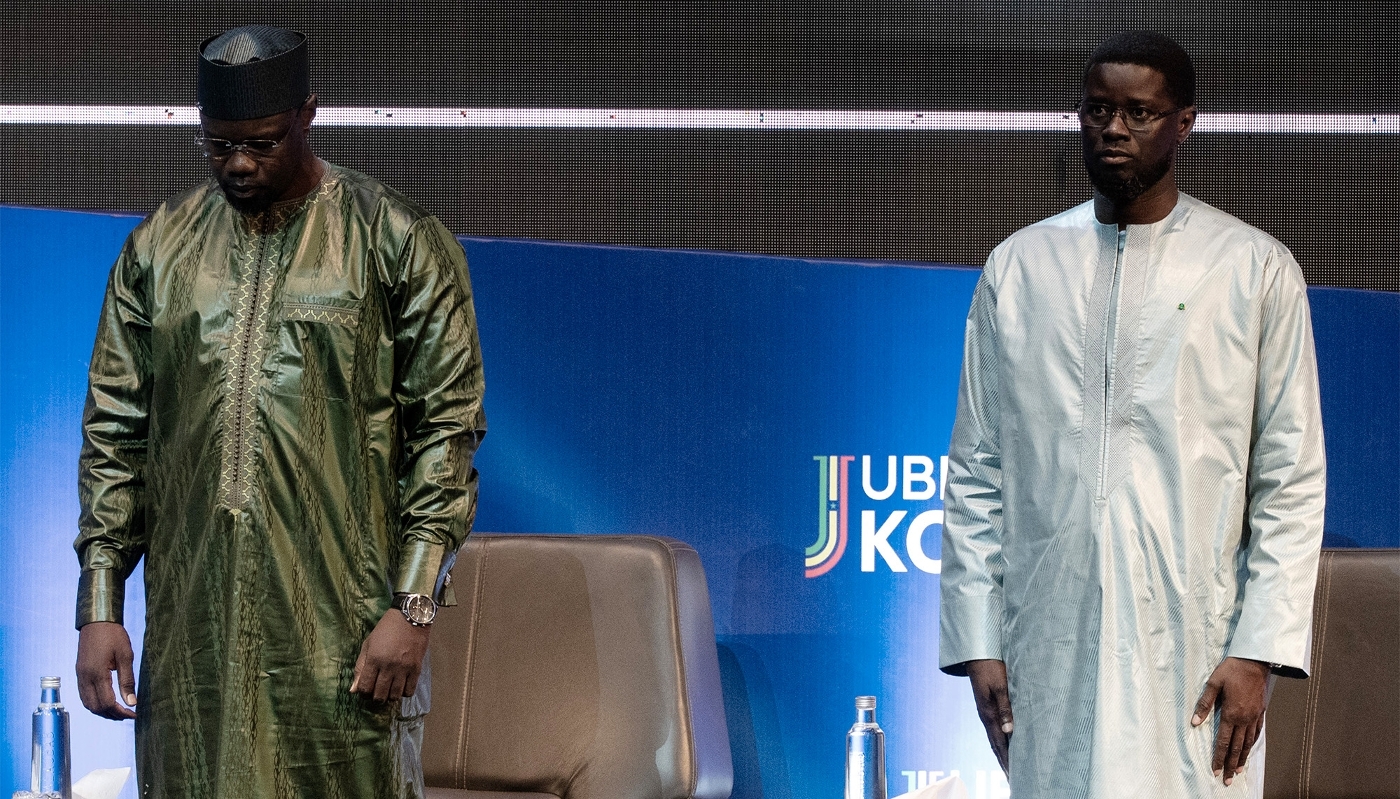
Which brings us to the Senegal drama of an almost similar nature.
In 2024, President Sonko and Prime Minister Faye’s Pastef party won outright in the first round of elections on a promise of a profound political shake-up.
They vowed to fight corruption and an inherited economy mired in debt.
However, things have not gone according to plan, just as they failed with ED and Chiwenga.
Discord between the president and prime minister have been on display for months.
This made their governing alliance increasingly uncertain.
The biggest signal that things were set for an upheaval came in November 2025.
PM and Pastef leader, Sonko, called on President Faye to remove two of Faye’s allies.
Instead, President Faye reportedly dismissed an ally of PM Sonko, the coalition’s political coordinator, Mrs Aissatou Mbodj.
In response, the Pastef party said the president did not have the power to dismiss Mrs Mbodj and rejected Faye’s appointment of former prime minister Mrs Aminata Toure as her replacement.
The party asserted Faye “does not have the power to dismiss” Mbodj and bluntly declared it shares “neither the same values nor the same principles” with the president’s new appointee.
It signalled a deep ideological and political rift within the government.
The escalating tension soon spilt into the public sphere.
At the start of May, Faye criticised Sonko’s “excessive personalisation” within the ruling party.
“As long as he remains prime minister, it is because he has my confidence.
“When that is no longer the case, there will be a new prime minister,” Faye declared in a televised interview.
On the other hand, Sonko accused Faye of a “failure of leadership” for not backing him up against his critics.
A Strong Response
Unlike President Mnangagwa, celebrated by some like former MP Temba Mliswa, for always “playing the long game”, Faye has moved with decisiveness.
Last week, President Faye sacked Prime Minister Ousmane Sonko and dissolved the government.
The announcement was made on state television in a decree that said President Faye “has ended the duties of Ousmane Sonko… and consequently those of the ministers and secretaries of state who are members of the government”.
On Monday, he announced the appointment of Ahmadou Al Aminou Mohamed Lô as prime minister.
The recent measures are in stark contrast to President Mnangagwa, who has allowed his VP to continue dropping coded bars for a very long time.
While this may be part of his “long game strategy”, it has also served to create uncertainty and apprehension within both the government and the country.
This prolonged period of ambiguity, characterised by subtle internal friction, contrasts sharply with Faye.
Faye’s decisive actions reflect a preference for swift structural realignment over the protracted uncertainty being seen in Zimbabwe.
Senegal can now move forward with a singular objective on the contentious issue of its debt.
Its debt levels have reached the equivalent of 132 percent of its GDP, according to the International Monetary Fund (IMF).
Senegal is now the second-most indebted country in sub-Saharan Africa.
While Sonko adopted a hardline nationalist stance, publicly opposing any IMF-mandated debt restructuring, Faye favoured pragmatic compromise to stabilise the struggling economy.
Thus, the removal of the Prime Minister paves the way for Faye to implement his preferred method.
By prioritising clarity and immediate accountability, Mnangagwa can also help resolve the current tension and stabilise the political climate.
———————————————————————————————————-
Love what we do? We’re dedicated to opening up democracy, one article, video and story at a time. If you find our reporting helpful, you can support the Magamba Network team by buying us a coffee. It’s quick, easy, and makes a real difference!
————————————————————————————————————