

By Correspondent
Constitutional Amendment Bill No. 3 (CAB3) has already cleared the biggest legislative hurdles.
It passed both the National Assembly and Senate with the required two-thirds majority despite a contentious public consultation process.
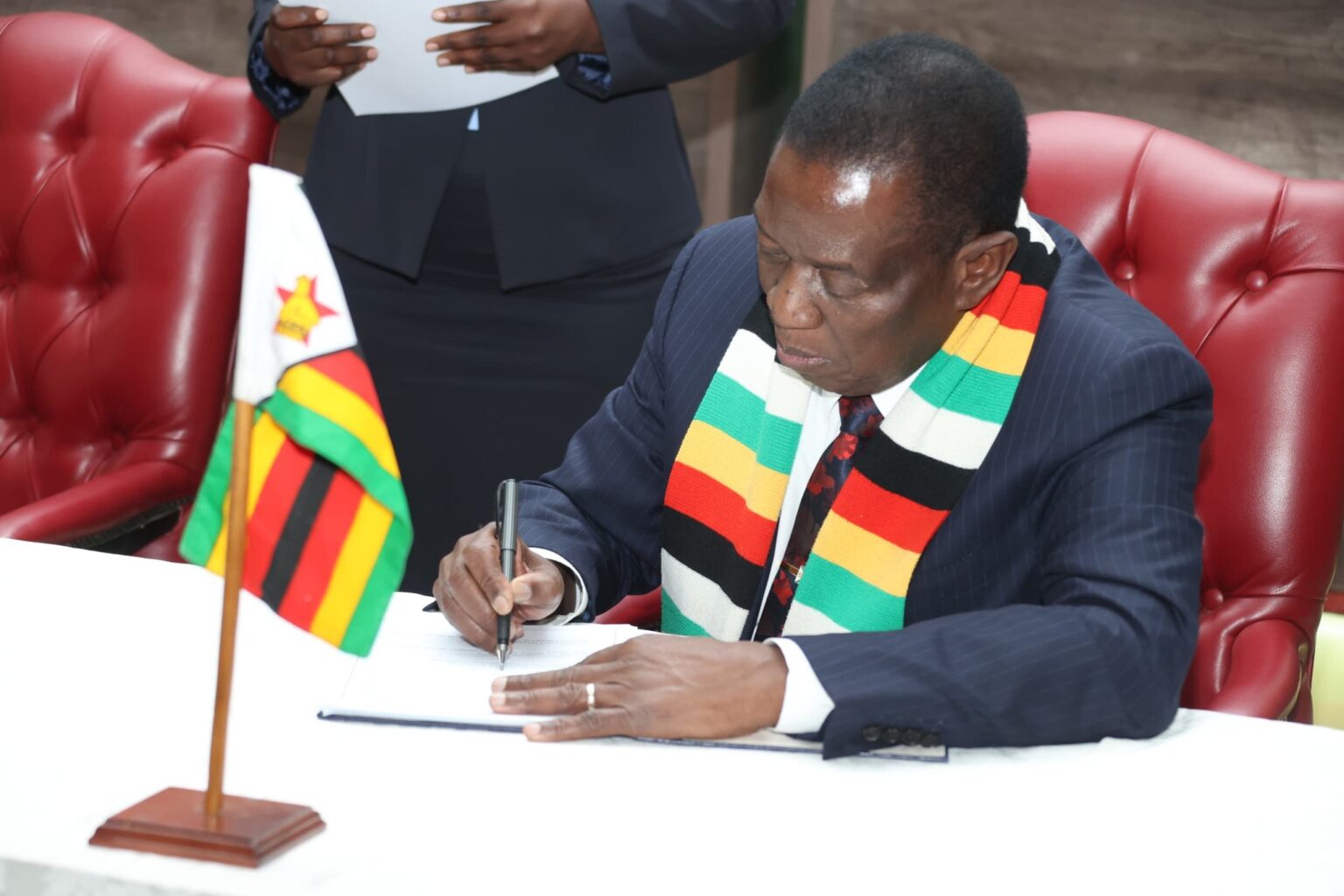
Yet, nearly a week after reaching President Emmerson Mnangagwa’s desk, one decisive step remains: presidential assent.
Ordinarily, signing a Bill into law is little more than a constitutional formality, but CAB3 appears different.
Mnangagwa’s signature would fundamentally alter Zimbabwe’s political architecture, changing how presidents are chosen, extending presidential and parliamentary terms from five to seven years, and allowing him to remain in office until 2030 instead of leaving in 2028.
The delay has transformed what should have been a routine administrative process into one of the most consequential decisions of Mnangagwa’s presidency.
More Than a Signature
Justice Minister Ziyambi Ziyambi has sought to downplay the significance of the delay, saying the President signs Bills “as and when he gets them.”
Yet the implications of CAB3 make this anything but routine.
The Bill replaces direct presidential elections with elections by Parliament and extends the life of both Parliament and the presidency by two years.
These are not technical amendments but changes that would redefine Zimbabwe’s electoral system for years to come.
Mnangagwa has repeatedly described himself as a constitutionalist and publicly maintained that he would serve only the two terms permitted under the current Constitution.
Assenting to CAB3 would place those earlier commitments under scrutiny, as the legislation would extend his stay in office beyond the mandate voters expected when they elected him in 2023.
The Succession Question
The delay has also fuelled speculation about succession within ZANU-PF.
Vice President Constantino Chiwenga reportedly cautioned members of the party’s Central Committee against celebrating the Bill’s passage, reminding them that it had not yet become law.
Whether intended as a procedural observation or a political signal, the remarks underscored that the final decision rests solely with the President.
Critics have long argued that CAB3 is not simply about constitutional reform but about managing succession by postponing the transition expected after Mnangagwa’s second term.
If that interpretation holds, every day the Bill remains unsigned prolongs uncertainty over the balance of power within the ruling party and the country’s future leadership.
The Referendum Debate
Beyond party politics lies a more fundamental constitutional question: should changes of this magnitude require approval by the electorate?
Section 328 of Zimbabwe’s Constitution protects certain constitutional provisions by requiring a national referendum before they can be amended.
Civil society organisations, constitutional lawyers and some former senior government officials argue that CAB3 falls within those protected provisions.
However, the government maintains that the Bill merely adjusts the electoral cycle rather than presidential term limits.
Opponents reject that distinction, arguing that regardless of the legal framing, the practical consequence is the same: The President remains in office for two additional years without seeking a fresh mandate from voters.
That legal dispute is likely to remain central regardless of whether Mnangagwa signs the Bill.
A New Legal Challenge
The political debate has recently been complicated by allegations surrounding the Bill’s passage through Parliament.
War veteran Reuben Zulu has filed an urgent High Court application alleging that businessman Wicknell Chivayo provided cash and luxury vehicles to legislators while CAB3 was still before Parliament.
The application seeks to stop the Bill from being transmitted to the President pending a full hearing.
The allegations remain untested in court, but they introduce a new dimension to the controversy.
Rather than challenging only the substance of CAB3, opponents are now questioning the integrity of the legislative process itself.
If proven, such claims could cast doubt over the legitimacy of Parliament’s approval.
A Defining Political Moment
Mnangagwa has built much of his political career on patience and calculated timing.
The delay may simply reflect a desire to allow legal challenges to unfold before making an irreversible decision.
Equally, it may serve a political purpose by keeping succession dynamics within ZANU-PF in suspense while avoiding an immediate confrontation over his constitutional legacy.
Whatever the reason, the stakes extend far beyond the President’s desk.
If Mnangagwa signs CAB3, Zimbabwe will replace direct presidential elections with parliamentary selection, extend electoral terms to seven years and postpone the next presidential transition until 2030.
If legal challenges succeed or assent is delayed further, the country gains more time to debate whether constitutional changes of such significance should be decided by Parliament alone or put directly to the people.
The legislation has already passed Parliament.
The courts may yet have their say.
However, at this moment, Zimbabwe’s political future hinges on a single presidential decision, one signature that could redefine the country’s constitutional order for years to come.
———————————————————————————————————-
Love what we do? We’re dedicated to opening up democracy, one article, video and story at a time. If you find our reporting helpful, you can support the Magamba Network team by buying us a coffee. It’s quick, easy, and makes a real difference!
————————————————————————————————————


