

By Correspondent
Parliament recently invited members of the public to submit comments on Constitutional Amendment Bill No. 3; however, the methods proposed have drawn ridicule.
Public members were offered to participate by either submitting comments via email or physically delivering them to the new Parliament building in Mt Hampden.
While this is a procedural requirement, the adequacy of the process remains highly questionable.
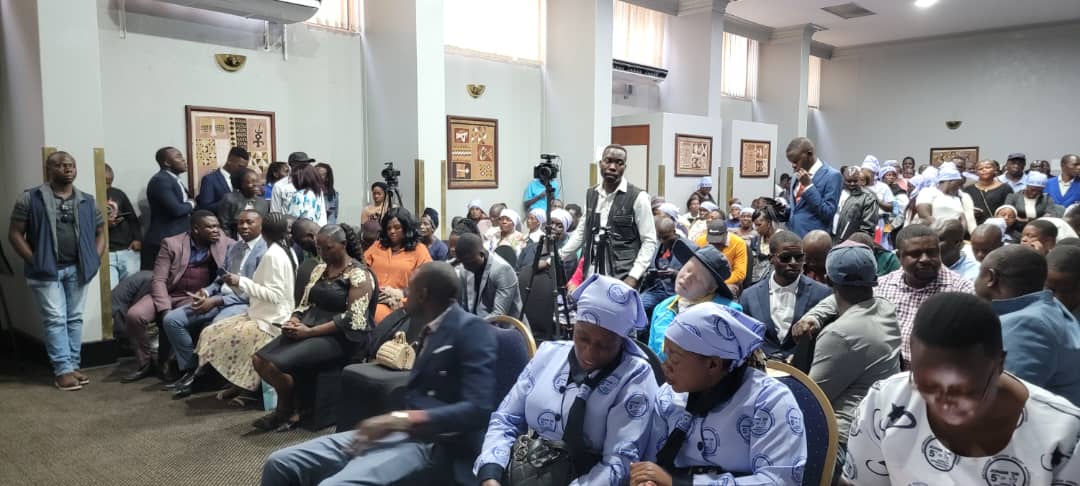
Addressing a press conference recently, National Constitutional Assembly leader Professor Lovemore Madhuku described the consultation exercise as meaningless.
He argued that the process excludes ordinary citizens.
“Public consultations are meaningless.
“There are no consultations taking place.
“This country has 16 million people, most of them have no access to an email, they have no access to Parliament.
“If you see the two methods, they don’t apply to ordinary people.
“The first one, you send an email; the second one, you physically visit.
Madhuku said one is expected to travel from as far as Mberengwa to the new Parliament building.
“A person from Harare finds it difficult to go all the way to the new Parliament building, but those are the two methods that are there.
“They have not put even a radio station where people can phone in, and we are all hearing what people want.
Due to these challenges, Madhuku said the exercise was meaningless.
Structural Problems
Madhuku’s concerns point to a broader structural problem: accessibility.
Internet access remains uneven, especially in rural Zimbabwe, where connectivity is unreliable, and the cost of data is high.
For many citizens, email is not a practical option.
At the same time, physically travelling to the New Parliament Building presents financial and logistical barriers.
This is most particular for citizens in distant areas.
In a struggling economy, transport costs alone can effectively silence participation.
There were several practical alternatives Parliament could have implemented to make the process more inclusive.
Members of Parliament, for instance, could have been mandated to collect written submissions within their respective constituencies and bring them when they come for parliamentary sittings.
This would have decentralised participation and brought the process closer to communities rather than requiring citizens to travel to the capital.
Traditional leaders, councillors and local authorities could have been designated as official collection points for written submissions.
Alternative Platforms
This would be most effective in rural areas where they remain influential community gatekeepers.
Additionally, churches, schools and community centres could have served as neutral venues for the collection of comments.
Radio platforms, especially vernacular language programmes, could have hosted call-in sessions to capture oral submissions.
Radios still have a wide reach across Zimbabwe.
These approaches would not only broaden access but also enhance public awareness and understanding of the proposed amendments.
The country is currently politically sensitive, particularly with debate intensifying ahead of 2028 when President Emmerson Mnangagwa’s second term is expected to end.
The credibility of constitutional reform processes becomes even more important.
Public trust is strengthened not by narrow compliance but by demonstrable efforts to include citizens from all walks of life.
Ultimately, a constitution belongs to the people.
Constitutional amendments altering the presidential term limits and who should benefit are foundational.
Hence, they demand not only technical compliance but genuine, inclusive and broad participation of citizens.
If public consultations are structured in a way that effectively excludes the majority, the legitimacy of both the process and the outcome will inevitably be questioned.