

By Correspondent
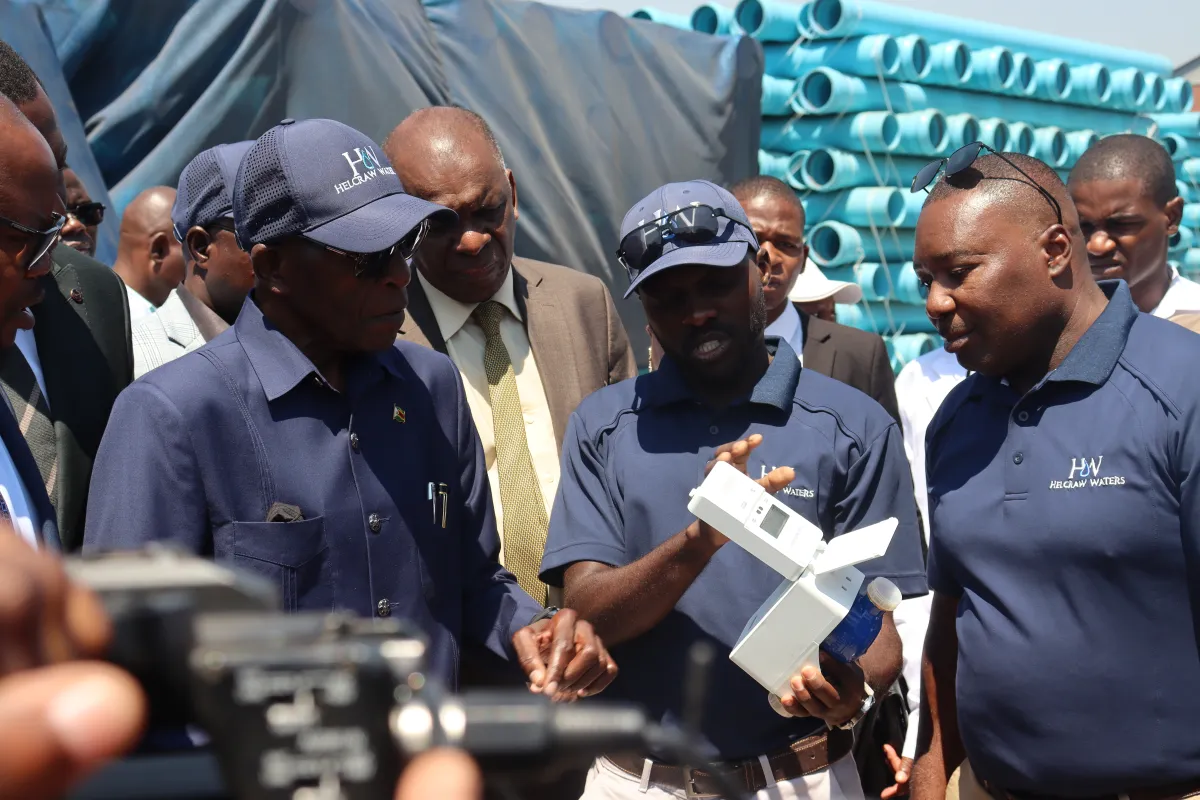
The City of Harare’s partnership with Helcraw has been rolling out prepaid water meters across the capital, replacing old postpaid meters.
Areas like the Avenues, Westlea, and Mabelreign have already been covered by the ‘pilot project’, which appears to serve the areas fortunate enough to encounter council water a few days a week.
That these areas, which receive water for about three days per week, are already considered better than the rest of Harare in terms of water supply summarises the service collapse that has embedded itself into the city’s identity.
According to state media reports, around 21 000 meters have been installed.
In its argument, Town House is saying that its revenue collection has been severely subdued, and these prepaid matters will help bring efficiency.
They are also bringing forward the theory that under the new method, ratepayers will be paying for the exact amount of water used, and the council will no longer be relying on estimates.
While the technical bits may be subject to debate, what is clear is that there is still a need for more nuanced debate on this subject from multiple perspectives.
Water and the Constitution of Zimbabwe
The right to access water is constitutionally protected through Section 77, which says every person has the right to safe, clean and potable water.
Being a constitutionally protected right means the state has to do everything within its power to ensure that its citizens have access to safe, clean and potable water.
Of the three aspects, cleanliness, safety and potability, none is being sufficiently met in Harare as things stand.
This means that the provision of water services in Harare, in which residents are afraid of drinking their tap water, contravenes the constitution.
In addition to the already precarious constitutional standing, the new water meters become an additional layer to the constitutional misgiving already persisting.
The new situation, where one can be cut off from the water supply because they do not have money, appears at the face of it to be a violation of Section 77 of the Supreme Law of the Land.
In a country where an estimated 88% of the population is not employed and therefore not guaranteed of an income at any given time, making water pay-before-use seems like an exclusionary policy position.
Of a Law That’s Older Than History Itself
In Zimbabwe, outside of the Constitution, domestic water in urban areas is governed by the Urban Councils Act.
This applies to all urban local authorities, including the City of Harare.
The law mandates Harare and other municipalities to manage the distribution of water.
In Harare specifically, the water is governed by a 1913 By-Law, best known as the 1913 Water Regulations, consummated through a Statutory Instrument.
When this by-law was passed, the bra (typically worn by women), the zipper and stainless-steel cutlery were still the latest global inventions.
This means new technology like pre-paid water meters, had not been anticipated when this law was adopted.
While the debate is still active, this could be the best time to interrogate the law, test if it is fit for purpose. Does the legislative intent held by the lawmakers in 1913 still apply to a city that has evolved like Harare?
The demographics are now different, the political circumstances have since changed, let alone the population size and the needs of those who occupy Harare presently.
It is said that the law is a living thing and there is a need to ensure the laws governing Harare water are not living in near medieval history.
High Court Judgments
The water debate is not new.
Over the many years passed, there have been a number of court cases instituted to compel the City of Harare to treat access to clean, potable water as a fundamental human right.
Left to its own devices, the city would convert water into a commodity.
In May 2014, Justice Chinembiri-Bhunu sitting on the Constitutional Court bench, ruled that Section 8 of the 1913 Water Regulations, which gives council right disconnect water supplies in non-paying households contravened Section 77 of the Constitution which guarantees access to clean and potable water.
Another key judgment was the High Court judgment of 2017, in Mushoriwa vs City of Harare, in which said that water supplies can only be cut off in the presence of a valid court order.
However, the ruling was overturned on appeal at the Supreme Court, meaning as things stand, the City of Harare can disconnect water, granted they have given notice to the affected ratepayer.
The current approach by the City of Harare, where one can lose access to water for non-payment through the pre-paid system, is consistent with current judge-made law on the matter.
Water and International Treaties
Zimbabwe’s Constitution in Section 34 provides for the adoption of all international conventions, agreements and treaties to which Zimbabwe is a party.
Since 1991, Zimbabwe has been a signatory to the International Covenant on Economic, Social and Cultural Rights. Signatories to this convention committed to observe the following: “the human right to water entitles everyone to sufficient, safe, acceptable, physically accessible and affordable water for personal and domestic uses.”
The introduction of pre-paid water meters seems to be inconsistent with the convention, as it sometimes the physical availability of the water in the event of the ratepaying being cut off for lack of funds.
Additionally, even those who have prepaid water meters have been getting water for a few days a week.
Regional Precedent
The idea is still fairly new in the Southern African region; countries are adopting it cautiously.
Some of the leading countries are South Africa (Tshwane), Namibia (Windhoek) and Kenya (Nairobi).
Studies have shown that there has been an improvement in the accuracy of readings and rates paid by the ratepayer.
However, there have also been reports of lowered household hygiene, as people try to manage the cost of water in suburbs like Jericho in Nairobi, which underwent the same program.
Harare is already plagued by cholera and typhoid; if household hygiene goes lower than it already is, the results may be dire.
There may be a need to subsidise the water or price it in a way that does not leave ratepayers in a space where they start self-rationing water to escape costs.
This is not to say there should be abuse of the resource, but the presence of prepaid water meters should not impede on what is generally accepted as normal use.
What’s Good for the Goose, Should Be Good for the Gander
Harare’s effort to plug leakages should not be one-sided.
For over a decade, the City of Harare has admitted that over 40 percent of the treated water is lost through infrastructure leakages.
Surprisingly, this glaring leakage has gone unaddressed for long; it has become part of the city’s identity, betraying inefficiencies.
Almost half of the water purified at a high cost is being lost, and there has not been any meaningful effort to correct this anomaly.
Water purification costs the city about $3 million monthly, which translates to $36 million per year.
Forty percent of that is around $14 million, and it seeps into the ground routinely.
If the problem of low revenue collection is to be solved in Harare, both the council and the residents should meet in the middle.
Residents have had to adjust their lives in the face of the pre-paid system, and the council also has to meet its end of the bargain.
Currently, the city has covered 21 000 households with this project. In the face of such spirited implementation, one hopes there is monitoring and evaluation so decisions are influenced by evidence and science.
By all means, Harare must grow and evolve; one just hopes there is consideration of the residents’ comfort as decisions are being made.
———————————————————————————
Love what we do? We’re dedicated to opening up democracy, one article, video and story at a time. If you find our reporting helpful, you can support the Magamba Network team by buying us a coffee. It’s quick, easy, and makes a real difference!
———————————————————————————